
Sep
How Schools Are Strengthening Safety With Professional Security Guards
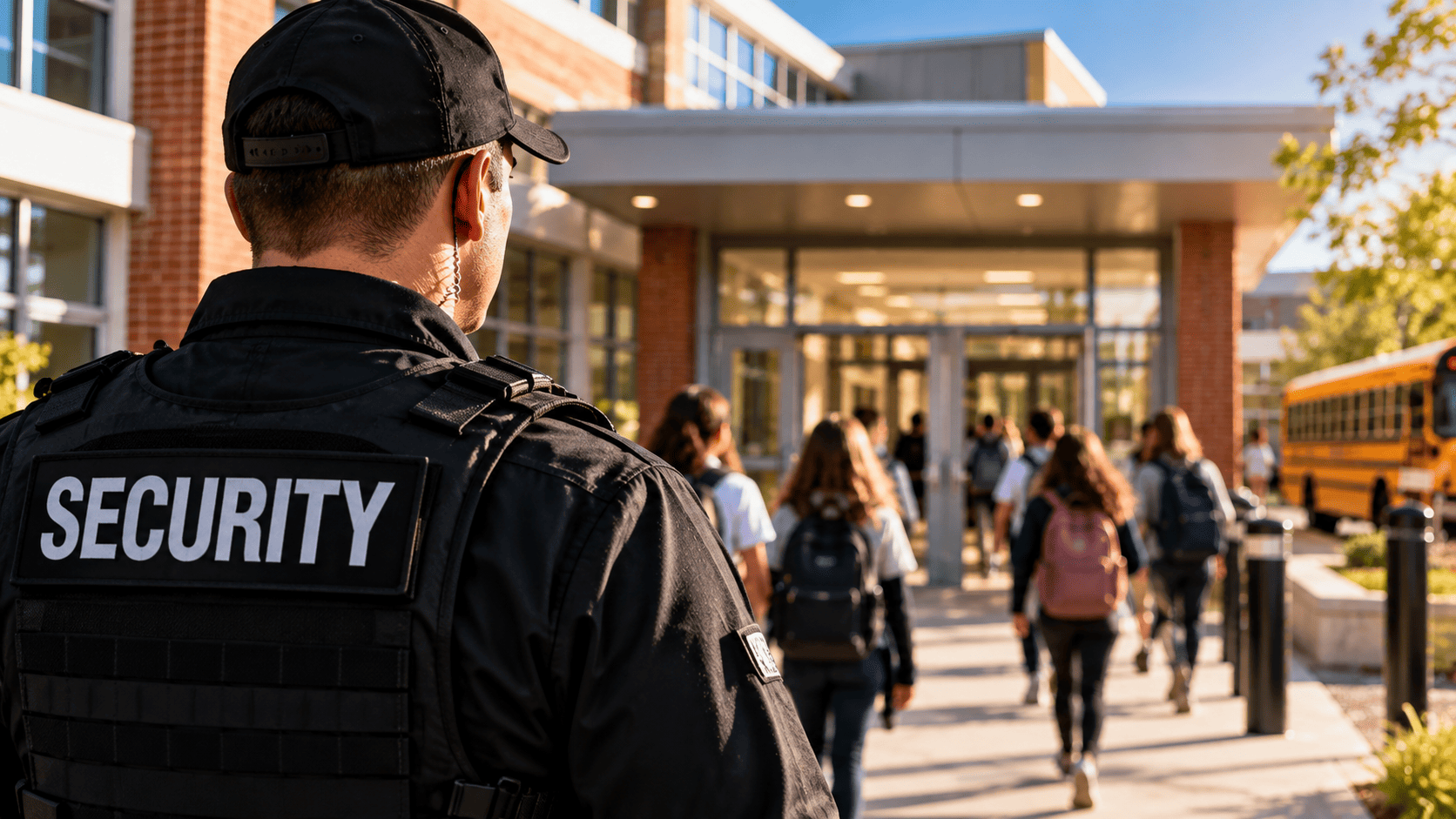
Schools are strengthening safety with professional security guards by putting trained people at the points where incidents actually start: the front entrance, arrival and dismissal, the parking lot, lunch and passing periods, and after-hours events. A guard checks in visitors, keeps doors that should be closed closed, notices the person who doesn’t belong, and is often the first adult on scene when something goes wrong.
In California, that work comes with specific training rules. Every security guard working on K-12 school district property must complete a 24-hour school security course developed by the Bureau of Security and Investigative Services (BSIS). That applies whether the guard works for the district or for a private security company.
Cameras and locked doors are already standard. According to the National Center for Education Statistics, 97% of public schools controlled access to their buildings and 93% used security cameras in the 2021-22 school year.
Staffing is where schools differ. Only 61% had security staff on campus at least once a week that year, down from 65% in 2019-20. The rest of this guide covers what a guard adds on top of the technology, how guards fit into a school’s safety plan, and what to ask before hiring one.
Where Security Guards Fit in a School Safety Plan
Every public school in California has to adopt a Comprehensive School Safety Plan and review it by March 1 each year, according to the California Department of Education. The plan has to cover emergency and disaster response, procedures for tactical responses to criminal incidents (including a person with a gun on campus), and how teachers are told about dangerous students.
A plan on paper doesn’t lock a gate or walk a visitor to the office. Guards are one of the ways a school carries out what the plan says. When the plan calls for a single controlled entrance, a guard is usually the person standing at it. When it calls for a lockdown, the guard is often the one confirming that exterior doors are secured and meeting first responders.
This works best when the guard’s post orders are written from the safety plan itself. If your plan says visitors must show ID and be escorted, that belongs in the guard’s instructions word for word.
We also recommend including guards in drills, since the first real lockdown is a bad time to learn where the shutoff for the front gate is. Our guide to building shooting preparedness strategies goes deeper into drills and response planning.
What a School Security Guard Does During the Day
A school day has predictable pressure points, and a good security plan staffs around them rather than spreading coverage evenly.
Arrival
The morning drop-off is one of the busiest and least controlled times on campus. Gates are open, cars are backing up into the street, and hundreds of students arrive in 30 minutes. A guard at the main entrance watches who comes in on foot, keeps the drop-off lane moving, and closes the perimeter once the bell rings.
During Classes
Once classes start, the job shifts to access control. The guard supports the front office with visitor check-in, checks that side doors and gates stay closed, and walks the perimeter on a set schedule. Lunch and passing periods get extra attention, because that’s when fights and conflicts between students are most likely to start.
Dismissal
Dismissal brings the same crowding as arrival, plus a new risk: students leaving with the wrong adult. Guards help staff manage pick-up lines and keep an eye on vehicles and people lingering near campus. They also stay visible until the last students are gone.
After Hours and Events
Football games, back-to-school nights, and weekend facility rentals bring large crowds onto campus when fewer staff are around. Overnight and weekend coverage also protects against vandalism, break-ins, and people camping on school property. Many schools add security for these hours even if they don’t use guards during the school day.
Security Guard, School Resource Officer, or Campus Supervisor?
Parents and board members often use these titles interchangeably, but they are different jobs with different authority.
| Role | Who employs them | Typical duties | Authority |
|---|---|---|---|
| School Resource Officer (SRO) | Local police or sheriff’s department | Law enforcement on campus, investigations, arrests, liaison with police | Sworn peace officer |
| District school security officer | The school district | Patrols, access control, supervision, incident response | Not sworn; completes the 24-hour BSIS school security course |
| Contracted security guard | A licensed private security company | Access control, entrances, patrols, events, after-hours and overnight coverage | Not sworn; holds a BSIS Guard Card and completes the 24-hour school security course |
| Campus supervisor | The school or district | Supervising students at lunch, recess, and passing periods | Staff member, not a security role |
A contracted guard isn’t a replacement for an SRO, and it doesn’t try to be. What a security company offers is flexibility. Coverage can grow for a football season, a construction project on campus, or a period of threats, and shrink again without adding district headcount.
Training Requirements in California
California sets a school-specific training floor for anyone guarding a K-12 campus. Under Business and Professions Code Section 7583.45, all security guards and school security officers working on the property of a K-12 school district must complete a 24-hour course developed by BSIS with the Commission on Peace Officer Standards and Training, according to the BSIS school security guard FAQ.
That rule covers district employees and guards supplied by a private security company. For officers the district employs directly, Education Code Section 38001.5 adds that the district must provide the training during regular work hours. Since July 1, 2021, part-time officers working 20 or fewer hours a week are covered too.
Contracted guards also need everything a security guard needs anywhere else in California. That means a BSIS Guard Card, 8 hours of training before registration, 32 more hours within six months, and 8 hours of continuing training every year. The company itself must hold a Private Patrol Operator (PPO) license.
In practice, ask any security company for proof that the officers assigned to your campus have finished the school course, not just the Guard Card. It’s also worth asking how officers practice situations like a student fight, an upset parent, or a lockdown. We cover why that practice matters in our article on scenario training for security guards.
Armed or Unarmed at a School?
Most K-12 campuses are best served by unarmed guards. Most of the job is supervision, access control, and calming tense situations between students or parents. A guard who is approachable and good with people prevents more problems than one who looks like a checkpoint.
Some districts do choose armed coverage, usually for specific risks or after-hours posts. In California, an armed guard needs a separate BSIS exposed firearm permit on top of the Guard Card. The decision should also be checked against district policy, the safety plan, and the school’s insurance. We walk through the tradeoffs in unarmed vs. armed security guards.
What to Ask Before Hiring a Security Company
A few questions separate companies that understand schools from companies that just fill shifts.
First, check the license and the training. The company should have an active PPO license, and every officer should have an active Guard Card and the school security course. Licenses can be verified with BSIS. Ours is PPO 15579. Verify that the officers being assigned to your school and/or campus are SB 1626 trained and certified.
Second, ask how officers are matched to a school. Working around children takes patience, and the right temperament matters as much as the license. Ask about background checks, and about customer service training, since guards deal with parents and students all day.
When hiring security for your campus, ask whether your officers have training specific to the educational environment. For California schools and qualifying community college properties, SB 1626 / California Business and Professions Code §7583.45 requires covered security personnel to complete specialized School Security Guard Training.
The curriculum addresses areas such as school security responsibilities, applicable laws and liability, conflict resolution, emergency response, and student behavior. Campus security requires more than simply having a guard on-site—it requires officers who understand the unique environment, responsibilities, and expectations of protecting students, staff, faculty, and visitors.
Third, look at accountability. Schools need to know that the guard was actually at the gate during dismissal. Our officers clock in and out through our mobile app and client panel, and incidents are reported to the client in real time.
Fourth, ask about the budget. Private and faith-based schools may qualify for security grants, which can make coverage more affordable. We explain how in our post on security for faith-based schools and grants.
For a complete checklist, see our 11 questions to ask when hiring a security guard company.
Planning Security for Your Campus
All Nation Security Services provides licensed security officers for K-12 schools, private and faith-based schools, and college campuses in California, Nevada, Texas, and Florida. If you’re reviewing your school safety plan or preparing for a new school year, request a quote and we’ll build coverage around your bell schedule, entrances, and events.
Frequently Asked Questions (FAQ)
What Does a School Security Guard Do?
A school security guard controls access to campus, checks in visitors, patrols the perimeter, supervises arrival, dismissal, and lunch, and responds first to incidents until staff or police take over. Guards also write incident reports and help carry out lockdowns and evacuations from the school’s safety plan.
How Much Does It Cost to Hire a Security Guard for a School?
Cost depends on the number of officers, armed or unarmed coverage, total weekly hours, and whether events or overnight posts are included. Schools with a fixed bell schedule can usually plan coverage precisely, which keeps costs predictable. A quote based on your schedule and campus layout is the most accurate way to price it.
What Are School Security Guards Called?
Titles vary by district. Common ones are school security officer, campus security officer, school safety officer, and campus supervisor. A School Resource Officer (SRO) is different: an SRO is a sworn police officer or sheriff’s deputy assigned to the school.
Do School Security Guards Carry Weapons?
Most don’t. The majority of school security guards are unarmed, and their tools are a radio, a camera system, and their training. In California, a guard who carries a firearm needs a BSIS exposed firearm permit, and whether armed guards are allowed is set by district policy.
Do Private Schools Need Security Guards?
No law requires them to, but many private and faith-based schools hire guards because they don’t have access to a district security department or an SRO. Guards give them trained coverage at entrances and events. Some also qualify for security grants to help cover the cost.
How Do Security Guards Improve School Safety?
They add a trained adult at the places technology can’t cover on its own. A camera records someone walking through an open gate, but a guard can stop them, ask who they’re visiting, and walk them to the office. Guards also shorten response time, because someone is already on campus when an incident starts.