
Oct
Church and Religious Center Security: Balancing Safety and Welcome
The person who greets you at the church door on a Sunday morning, or the Synagogue door on Friday is often doing two jobs at once, whether anyone has said so out loud or not. They are welcoming you in, and they are also the first person who would notice if something was wrong. Most congregations have relied on that instinct for a long time. A growing number are now asking whether instinct is still enough.
That question does not have one right answer. A two-hundred-person church in a quiet suburb and a large synagogue in a major city are not solving the same problem. But the thinking that gets a congregation to the right staffing decision is the same everywhere, and it starts with being honest about what volunteers can and cannot do.
Why This Conversation Is Happening Now
Religious institutions have always balanced openness against risk, but two things have shifted that balance in recent years. The first is the federal government’s own recognition of the threat. The FBI’s most recent hate crime data, covering 2024, recorded 11,679 reported criminal incidents motivated by bias, with religion tracked as one of the core bias categories alongside race and sexual orientation. Houses of worship are not abstract targets in that data. They are specific buildings with specific schedules that make them easy to study from the outside.
The second shift is that federal funding now exists to do something about it. The Department of Homeland Security, through FEMA’s Nonprofit Security Grant Program, awarded $110 million to more than 600 faith-based and nonprofit organizations in August 2025, on top of a separate $100 million round earlier that summer. Churches, synagogues, mosques, and temples are all explicitly eligible, and the money can pay for cameras, access control hardware, lighting, fencing, and staff training.
We walked through the mechanics of applying, including the Investment Justification and state-level deadlines, in our earlier post on security grants for faith-based organizations. This article is about what to do with the money and the thinking once it arrives, not the application itself.
What a Volunteer Safety Team Can and Cannot Cover
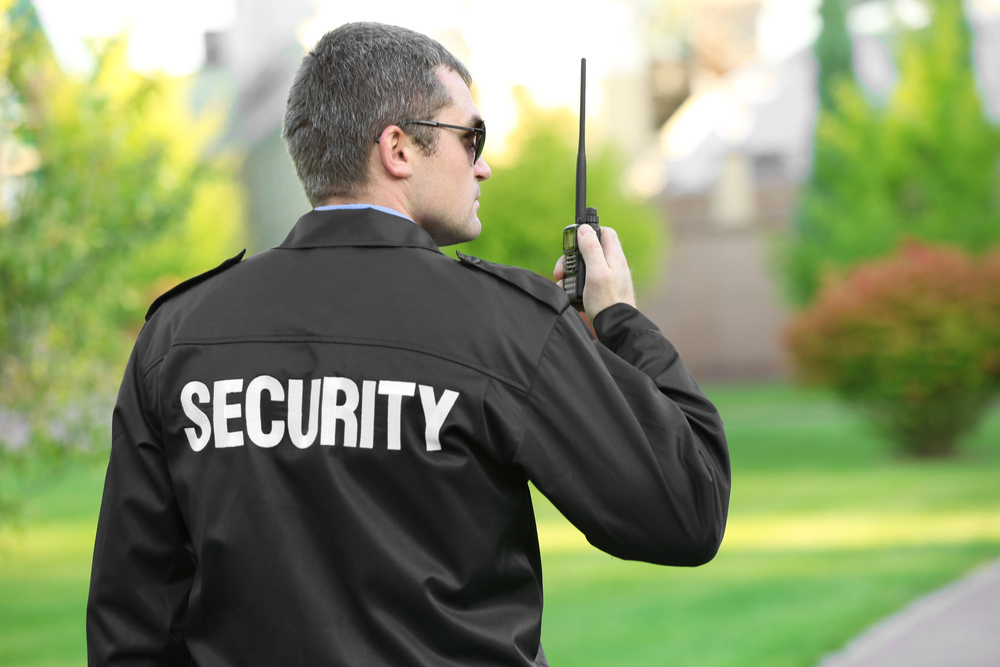
Most congregations start with volunteers, and there is nothing wrong with that as a first step. Ushers who know the building, parking lot greeters who notice an unfamiliar car, a deacon with a radio during the service. This works well for the things a volunteer team is actually built for: presence, familiarity, and a warm first impression.
Where it runs into limits is anything that requires consistency a congregation cannot guarantee from week to week. Volunteers rotate. Training varies by whoever happened to lead the last session. Most states do not require a volunteer greeter to carry any license at all, which means there is no outside standard holding the program together between one Sunday and the next. A licensed security officer, by contrast, is accountable to the same state requirements that govern every other security assignment we staff, from background screening to use-of-force training to the license itself.
That is not an argument against volunteers. It is an argument for knowing which parts of the job belong to them and which parts belong to someone trained and licensed for it, particularly parking lot traffic control, physical intervention, and anything involving a firearm.
Armed, Unarmed, or Both
Congregations ask this question early, and it deserves a direct answer: it depends on the building, the history, and the state. Firearms laws governing houses of worship vary significantly from state to state, including whether concealed carry extends onto religious property and what training is required of anyone carrying on behalf of the organization. Get specific legal guidance for your state before making this decision, not a general rule borrowed from another congregation’s policy.
What matters more than the armed-or-unarmed question is whether the decision was made deliberately, after looking at the building’s layout, past incidents, and the congregation’s own comfort level, rather than copied from another church down the road. We cover the broader trade-offs, including insurance and liability considerations, in our guide to unarmed versus armed security guards.
Designing Security That Does Not Feel Like a Checkpoint
The hardest part of this work for a congregation is not the hardware. It is keeping the building from feeling like an airport. A visible guard stationed rigidly at the front door can make first-time visitors uneasy at exactly the moment a church most wants them to feel welcome.
The better approach usually blends visibility and discretion. A uniformed presence makes sense during high-traffic events such as holiday services, funerals, or community outreach days, where crowds are larger and less predictable. During a normal Sunday, a plainclothes officer working alongside the existing greeter team, trained to watch without hovering, often does more good than a stationed guard ever could. Officers working in religious settings also need the same cultural fluency we discuss in our post on cultural competency in modern security services, including comfort with religious dress, customs, and the rhythm of a worship service, since an officer who reads as out of place undercuts the welcome a congregation is trying to extend.
Planning Beyond Friday evenings or Sunday Mornings
A congregation’s security needs do not stop when the sanctuary empties. Many houses of worship run a school, a daycare, or a food pantry on the same property during the week, each with its own traffic pattern and its own visitors who are strangers to the building. Weddings, bar mitzvahs and funerals bring guests who have never set foot inside before. Vacation Bible/Torah school fills a building with children on a schedule that looks nothing like Friday or Sunday service.
Each of these needs its own plan: who unlocks which doors, who is responsible for a lockdown decision, and how staff communicate if something goes wrong mid-week with far fewer people around than on a Sunday. Our post on how security officers support emergency preparedness planning covers how to build that kind of plan with a security partner rather than from scratch. Whatever program a congregation lands on, build in documentation from the start. Timestamped incident reports and patrol logs, the same daily activity reporting we recommend for any client, give a board or elder committee something concrete to review rather than a vague sense that things are fine.
Finding the Right Partner
All Nation Security Services has worked with religious and community organizations across California, Nevada, Texas, and Florida since 2004 as a woman, minority, and family-owned company, and we understand that a congregation’s security plan has to protect people without changing who the building is for. You can review our full range of security services or request a quote to talk through what your building actually needs.