
Aug
Parking Lot Security: A Guide for Property Managers and Businesses
The parking lot is the part of a property almost nobody plans for. It gets designed by a civil engineer for drainage and traffic flow, striped, lit to code, and then handed over. Security shows up later, usually after something happens.
That sequence is backwards, and it is why parking lot security guard services so often get bought in a hurry, under pressure, with no clear picture of what the coverage is supposed to prevent. Getting it right starts with understanding why these spaces behave differently from the buildings they serve.
Why Parking Areas Concentrate Risk
A lot or garage combines several conditions that rarely appear together anywhere else on a property.
People are alone, distracted, and carrying things. They are also in transition, which means nobody has a reason to notice a stranger standing between rows of cars. Sight lines are broken by vehicles, columns, and landscaping at exactly the height that hides a person.
Then there is the ownership problem. Everyone crosses the lot and nobody feels responsible for it. Tenants think it belongs to the landlord, the landlord treats it as an amenity, and the result is a space with heavy use and no informal supervision.
Property crime follows that combination. So do the confrontations that begin with a dispute over a space and end with an incident report.
Walk It After Dark Before You Buy Anything
The single most useful exercise costs nothing. Go to the lot at 9 p.m. on a weekday, without a flashlight, and walk the whole thing at a normal pace.
- Note every place where you cannot see the exit. Those are the spots people will avoid, and the spots that need attention.
- Look up. Count the fixtures that are out, dim, or blocked by tree growth. Lighting failures are the most common and most fixable finding in any lot.
- Check the corners where the lighting overlaps poorly. Uniform coverage matters more than raw brightness, because deep shadows next to bright pools are worse than moderate light everywhere.
- Find the pedestrian route from the farthest space to the entrance and walk it. If it passes behind a dumpster enclosure or through an unlit row, that is the route your employees take every night.
- Look at the perimeter. Where can someone enter on foot without passing anything, and where can they leave the same way?
- Note the cars still parked. A lot with overnight vehicles has a different risk profile than one that empties.
This walk usually reshapes the assignment. A property about to hire an overnight guard discovers its real problem is a burned-out pole and an unlocked stairwell door. Another finds that the risk window is the shift change at 11 p.m., not the middle of the night.
Surface Lots and Structures Are Different Problems
The word parking covers two environments that need different answers.
A surface lot is open and observable. Its weaknesses are perimeter access, lighting uniformity, and distance from the building. A patrol vehicle covers it efficiently, and improvements to light and sight lines go a long way.
A parking structure is a set of enclosed rooms stacked on top of each other. Stairwells, elevator lobbies, and lower levels are the concern, and none of them can be observed from outside. Vehicle patrol misses exactly the places that matter, because the risk sits where a car cannot go.
If your property has a structure, foot coverage of stairwells and elevator lobbies belongs in the scope explicitly. Vendors will not include it unless you ask.
What the Evidence Says About Cameras
Cameras get proposed as the cheaper alternative to staffing. The research supports part of that argument and contradicts the rest.
The National Institute of Justice, through its CrimeSolutions review, rates CCTV surveillance as Promising for reducing overall crime, property offenses, and vehicle crime. For violent offenses, the same review rates it Ineffective, finding no statistically significant effect across the studies examined.
Read that split carefully, because it maps directly onto the two things a lot has to handle.
Cameras are a reasonable, evidence-supported response to break-ins, catalytic converter theft, and vandalism. They are not a substitute for a person when the concern is someone being followed to their car. The review also notes that actively monitored systems perform differently from those that only record, which is the practical difference between a camera that prevents something and one that documents it afterward.
The same logic applies to the guards-versus-cameras question generally, which we cover in live security cameras vs. security guards.
Fixed Post or Patrol
Once you know where and when the risk sits, the staffing model follows.
A fixed post at an entry or exit works when the concern is controlling who comes in, when the lot has a single choke point, or when a visible deterrent at a specific hour is the goal. It does nothing for the far corner of a large lot.
A roving patrol, on foot or by vehicle, suits large or multi-level properties where exposure is spread out. It trades constant presence for coverage, and the timing has to vary or it becomes a schedule people can work around.
Many retail and mixed-use properties end up with a hybrid: a fixed presence during the closing window when employees walk out, and patrol coverage the rest of the shift. Escort service to vehicles after dark costs almost nothing to add and is one of the few security measures employees actually notice and value. Our security patrol coverage is built to flex between these models as a property’s pattern changes.
The Liability Question
Premises liability claims involving parking areas usually turn on a single issue: what the property owner knew and what they did about it.
Prior incidents on or near the property, complaints from tenants or employees, and police calls to the address all establish notice. Once notice exists, the question becomes whether the response was reasonable.
This is the argument for documenting both the problem and the response. A file showing that the lighting audit happened in March, the fixtures were replaced in April, and patrol coverage was added in May tells a very different story than an owner who cannot produce anything.
Consistency matters as much as documentation. Officers need written direction on how to handle loitering, how to approach someone sleeping in a vehicle, and what they should never attempt on their own. Situations involving unhoused individuals in particular require a specific approach, which we address in our post on security plans for homeless encounters.
Knowing Whether It Is Working
Set the measures at the start rather than arguing about them at renewal. Vehicle break-ins per quarter, after-hours incident volume, and time from incident to report delivery are all straightforward to track.
Add one qualitative measure that most properties skip: ask employees or tenants whether they feel comfortable walking to their car after dark, and ask again in six months. That answer moves before the crime numbers do, and it is frequently the reason ownership approved the spend in the first place.
Review the data quarterly with your account manager and move coverage that is not producing. Hours parked in the wrong place cost the same as hours parked in the right one.
Covering the Space Between the Car and the Door
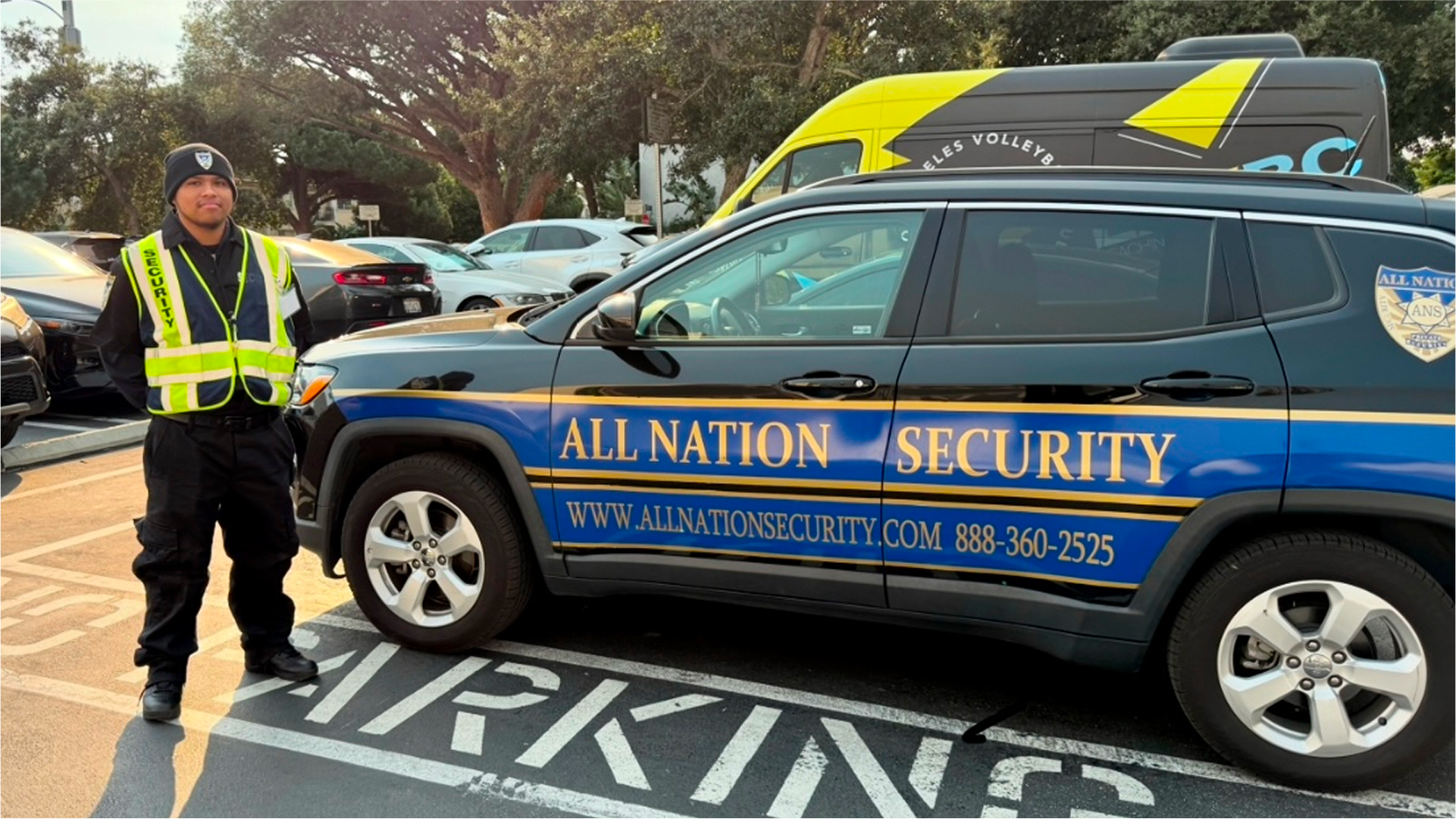
All Nation Security Services protects retail centers, office properties, and mixed-use sites across California, Nevada, Texas, and Florida, and has done so for more than twenty years as a woman, minority, and family-owned company.
We scope parking coverage around a property’s layout, traffic pattern, and incident history rather than a standard shift block.
See the full range of industries and properties we serve, or request a quote and walk your site through with our management team.