
Oct
Warehouse and Logistics Security: A Guide for Peak Season
Every warehouse and distribution center operator knows the feeling of the first week of November. Order volume climbs, temp staff show up in waves, trucks start queuing at the gate earlier in the morning, and the whole operation runs closer to its limits than it does any other time of year. Those same weeks make the fourth quarter, and they are also when warehouse security has the least margin for error.
That is not a coincidence, and it is not just a staffing problem. It is a timing problem. A gate officer or a warehouse guard can do the job well in July and still get caught flat-footed in December if the program was never built to scale with volume in the first place. Good industrial security is planned around the busiest week of the year, not the average one.
Why Peak Season Changes the Risk Picture
Cargo theft does not spread evenly across the calendar. Verisk’s CargoNet tracked 353 theft, hijacking, and fraud events across five recent year-end holiday windows, with reported events climbing roughly 82 percent between 2020 and 2024. December 23 alone accounted for about 16 percent of all incidents in that window, and California, Texas, Illinois, and Florida, the same four states All Nation Security Services operates in, led the country in reported events. Vehicle parts, alcohol, and electronics were the goods targeted most often.
That pattern lines up with what any operations manager already knows intuitively. More trucks moving through the gate means more opportunities for a load to leave without the right paperwork behind it. More unfamiliar faces on the warehouse floor, many of them temporary hires who started the week before, means more opportunities for something to walk out a side door unnoticed.
We cover the broader case for logistics security technology, including tracking and surveillance, in our earlier post on logistics security solutions. This article is about the part that technology alone cannot cover: staffing the gate and the floor for a volume spike that lasts about ten weeks a year.
Staffing the Truck Gate for Surge Volume
A gate officer’s job during peak season is less about standing watch and more about verification, done quickly enough that the queue does not back up onto the street. That means confirming a driver’s identity against the day’s dispatch schedule, matching the cargo manifest to the load before it is released into the yard, and catching the paperwork gaps that let an unauthorized trailer through on a normal day without anyone noticing until the count comes up short.
Officers working a gate for a shipper or 3PL operating under Customs and Border Protection’s C-TPAT program need to understand why that documentation chain matters beyond site security. C-TPAT is a voluntary CBP partnership that asks participating carriers, importers, and logistics providers to maintain a documented, verifiable security process across their supply chain, and a gate that cannot account for who entered, what they carried, and when they left undermines that certification regardless of how good the rest of the program looks on paper.
Our officers working gate assignments are trained on yard management system logging alongside manifest collection, so trailer dwell time and an unscheduled arrival both get flagged the same way an unmanifested load would.
We go deeper on the guard-versus-clerk question specifically, including liability and response time, in our post on staffing truck gates. The difference at peak season is volume: a gate that handles twenty trucks a day in June might see fifty in December, and the documentation discipline has to hold at either pace. Our trucking and fleet security services extend the same standards from the gate into the yard and the road.
Screening the Seasonal Workforce Inside the Building
Distribution center security gets harder every November because most facilities bring on significant temporary headcount for the fourth quarter, often through a staffing agency rather than direct hire. OSHA’s guidance on temporary workers in warehousing is clear that the host facility, not the staffing agency, carries primary responsibility for site-specific safety training, because the host controls the work methods and knows the hazards. Security has a parallel role to play here that is easy to overlook in the rush to get bodies on the floor: verifying identity at intake, issuing and tracking temporary badges, and enforcing restricted-area access for anyone who has not completed site orientation yet.
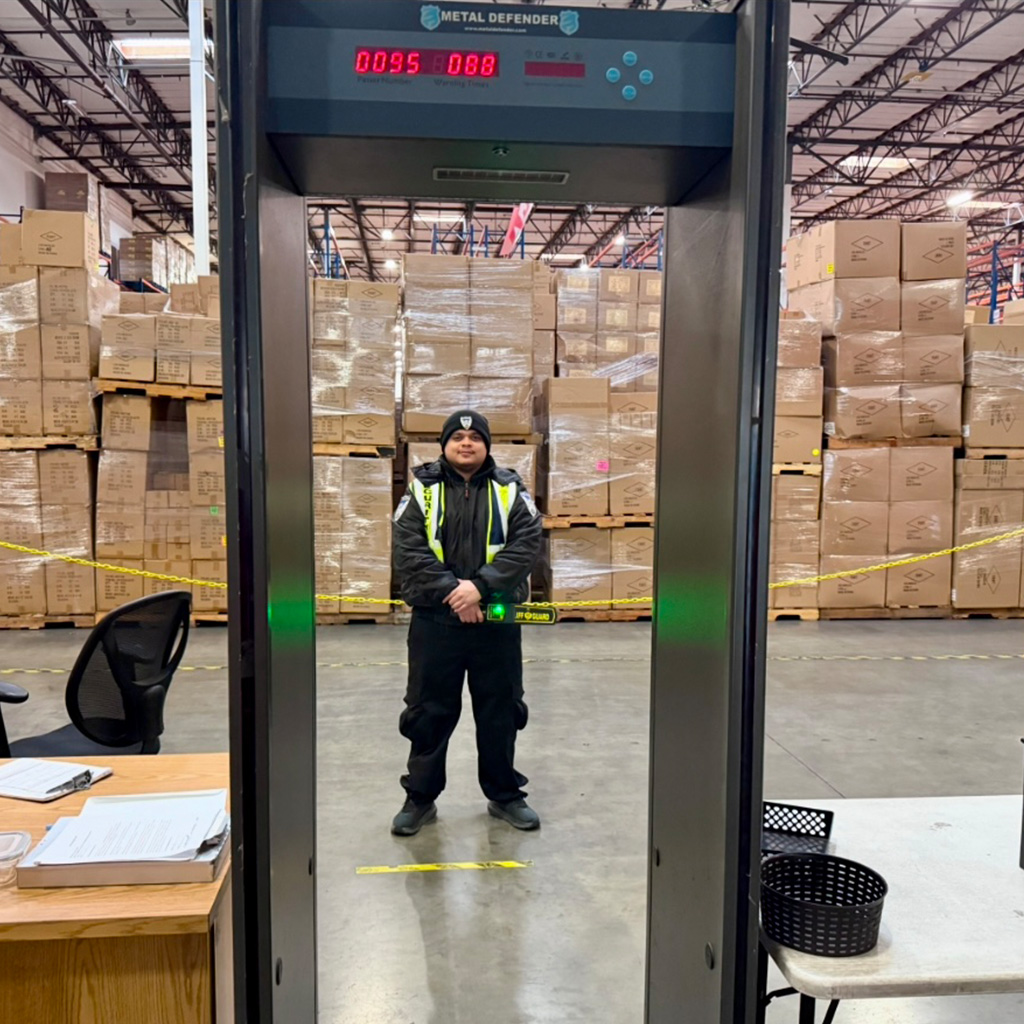
Wanding and bag checks at shift change, applied consistently rather than selectively, do more than deter theft. They protect the temp workforce itself, since a consistent policy applied to everyone is far easier to defend than one that singles people out. We cover the broader responsibilities of an on-site warehouse officer, including access control and incident response, in our post on warehouse security guards and facility compliance, which this peak-season staffing challenge builds directly on top of.
Patrols That Hold Up at Triple the Normal Volume
More inventory moving through more dock doors creates more blind spots, especially once overtime shifts push operations later into the night. Patrol routes that make sense in a quiet August need to be reworked for a December floor plan with staging areas in aisles that are normally empty.
The patrol log and the gate log should talk to each other. An officer closing out a dock door at the end of a shift is effectively confirming that everything logged out matches what was logged in at the gate earlier that day, and that reconciliation only works if both records are accurate and timestamped in real time. Our clients track this through the same administration panel and mobile app we use across every site, with hourly logs and verified clock-ins rather than an end-of-shift summary written from memory.
Planning Before November Hits
The operators who handle warehouse security well in peak season are the ones who start the staffing conversation in September, not the week before Black Friday. That gives enough runway to train gate officers on a specific facility’s manifest and YMS process, brief warehouse officers on the season’s layout changes, and scale headcount up before the volume arrives instead of catching up after it does.
All Nation Security Services has provided warehouse security guard services to logistics, trucking, and distribution operations across California, Nevada, Texas, and Florida since 2004 as a woman, minority, and family-owned company. Review our full security services or request a quote to build a peak-season staffing plan before the surge starts.