
Sep
Film & Television Set Security: What Productions Need to Know
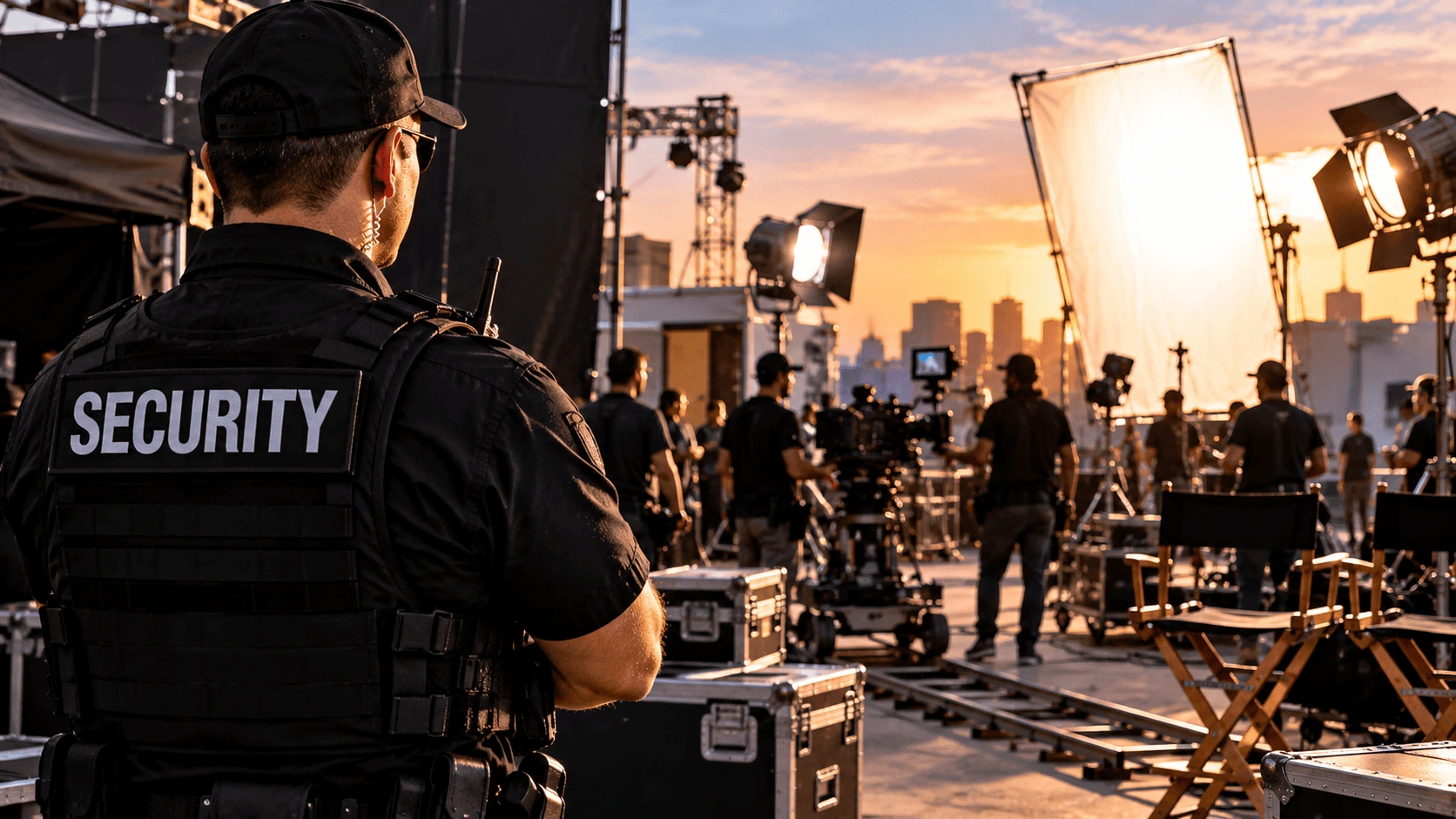
Film and television set security is the licensed, on-site protection a production hires to control who gets onto the set, guard equipment and vehicles at basecamp, watch the location overnight, and keep the public away from cast and crew while cameras roll.
In California, anyone doing that work for pay needs a Guard Card from the Bureau of Security and Investigative Services (BSIS), the company employing them needs a Private Patrol Operator (PPO) license, and an armed officer needs a separate exposed firearm permit on top of that.
What private security can’t do matters just as much. On public streets in the Los Angeles area, traffic holds, street closures, and prop gunfire require uniformed police officers assigned through the film permit, and many shoots also get a Fire Safety Officer from the fire department.
A good set security plan covers everything those roles don’t: the overnight hours, the basecamp, the crew parking lot, the company move, and the private property where a permit officer has no assignment.
Why Film Sets Are Harder to Protect Than Most Job Sites
We protect construction sites, warehouses, and office towers every day. A film set breaks most of the assumptions those posts are built on.
The address changes. A TV episode can shoot at three or four locations in a week, and each one has different entry points, neighbors, and parking. The valuables move too: camera packages, lens cases, grip and electric trucks, generators, wardrobe racks, and the drives that hold the footage. Most of it is rented, so a theft is a replacement bill and a scheduling problem at the same time.
The crew is also large and constantly changing. Day players, background actors, caterers, and vendors come and go, and anyone in black with a radio on their hip looks like they belong. Add long days, trucks parked on public streets overnight, and neighbors or fans curious about what’s being filmed, and you have a site where the usual “know every face” approach doesn’t work.
There’s also more of this work coming. California raised its film and TV tax credit cap from $330 million to $750 million a year, and FilmLA reports that 170 projects have been awarded credits under the expanded program, with most of them shooting now or starting soon.
Los Angeles logged 4,711 on-location shoot days in the second quarter of 2026, still down 12.7% from a year earlier, so the recovery is gradual. But incentivized productions are the ones returning to local streets, and they bring the same security questions with them.
Who Does What on a Los Angeles Location Shoot
This is where most productions get confused, so it’s worth laying out plainly. Three different people can show up in uniform on a location shoot, and they do different jobs.
| Role | Who provides it | What they handle | What they don’t handle |
|---|---|---|---|
| Permit police officer | Hired through the film permit (LAPD, Sheriff, or the local city’s department) | Intermittent traffic control, street and lane closures, prop weapons and simulated gunfire on location, scenes with actors in police uniform | Watching your trucks overnight, checking crew credentials, basecamp |
| Fire Safety Officer | Assigned by the fire department’s film unit | Pyrotechnics, open flame, special effects, and in some cities most interior shoots | General security or access control |
| Private security officer | A BSIS-licensed security company | Access control, check-in, basecamp and equipment, crew parking, overnight posts, talent escorts, crowd management on private property, incident reports | Directing traffic or holding pedestrians on public streets |
The FilmLA rules are specific. Under LAPD’s officer assignment chart, holding traffic on a two-way street takes at least two officers, one at each end of the break, and holding an intersection takes four to six. An officer assigned to a scene with simulated police activity can’t also do traffic control.
FilmLA’s community guidance states that film crews aren’t allowed to direct traffic, and that vehicles can be held for up to two minutes only with uniformed traffic officers. Brandishing or firing prop weapons requires a police officer on site.
Those officers also cost real money, with minimums. In Manhattan Beach, for example, a permit police officer is billed per hour with a four-hour minimum plus an hour of travel time. That is one more reason not to stretch a permit officer into security work they weren’t hired for.
FilmLA’s own chart notes that a missing officer doesn’t relieve the production of responsibility for safety, and the same logic applies to security: the permit tells you who is required, not everything you need.
What Private Security Covers, Phase by Phase
A production doesn’t need the same coverage on day one as it does at 2 a.m. on day four. We plan set security in phases, and we write each one into the post orders so every officer knows exactly what the job is at that location.
Prep and Load-In
Before the first truck arrives, we walk the location with the locations department. We look at every entry point, where basecamp and crew parking will sit, where background actors will hold, and where the public is likely to gather. Load-in is the first exposure point, because gear is coming off trucks and doors are propped open.
Shoot Day
Most of the day is access control. We run a check-in point against the production’s crew list and call sheet, issue or check credentials, and keep a separate holding area for background performers. When talent walks between trailers and set, an officer can clear the path.
Set etiquette matters here. When the AD calls “rolling,” officers stay still and quiet, keep out of frame, and don’t key their radios near sound. On photo and phone policies, officers enforce the production’s rules, not their own. If the production says no photos past check-in, that’s the rule we hold.
Overnight
This is where productions lose the most gear. Trucks, generators, cable runs, and dressed sets often stay in place between shoot days. Depending on the layout, we use a fixed post at the truck line, a roving patrol, or both. Officers log activity through the night, and those daily activity reports give the production a record if something goes wrong.
Company Moves and Wrap
This is the riskiest part of the day and the one most often left uncovered. Equipment is staged on the sidewalk, lift gates are down, and everyone is tired and focused on packing. We keep an officer on the staging area until the last truck is closed and locked.
Armed or Unarmed on a Film Set?
Most location work should be unarmed. Officers spend the day around crew, talent, and the public, and their job is mostly access control and de-escalation. There’s also a practical issue: sets with prop weapons already have an armorer and, on location, a permit police officer. A second, real firearm near the set adds confusion without adding protection.
Armed coverage can make sense for overnight posts in high-theft areas or for high-value equipment that sits unattended. If a production goes that route, we keep armed officers at the perimeter or basecamp, away from the working set.
In California, carrying a firearm on duty requires a separate BSIS exposed firearm permit, which involves a 14-hour course with classroom and range time. We go into the tradeoffs in more detail in our guide to unarmed vs. armed security guards.
How to Vet a Security Company for a Production
Production schedules shift constantly, so the security company has to keep up. Before hiring anyone, we’d suggest checking these points.
First, confirm the license. Every California security company needs an active PPO license, and every officer needs an active Guard Card. Both can be checked on the BSIS license lookup. Ours is PPO 15579. The state’s security guard laws apply on a film set exactly as they do anywhere else.
Second, ask about set experience. An officer who has never worked a set will walk through a shot or chat during a take. Ask whether the officers assigned to you have worked productions before.
Third, look at reporting and billing. Shoot days run long and call times change. Our officers clock in and out through our mobile app and client panel, so the production sees who was on post, when, and any incident reported in real time, and billing reflects the actual minutes worked.
Fourth, check how the company handles short notice. Added days, split days, and overnight holds are normal on a production. A security company should be able to staff them without a week of lead time.
For a broader checklist, see our 11 questions to ask when hiring a security guard company.
Planning Security for Your Next Shoot
All Nation Security Services is licensed in California, Nevada, Texas, and Florida, and we provide film production security services for location shoots, stages, and overnight holds. If you have a shoot coming up, request a quote with your dates, locations, and call times, and we’ll build a plan around them.
Frequently Asked Questions (FAQ)
Do Film Sets in Los Angeles Legally Need Security Guards?
Not as a general rule. Film permits require police officers or Fire Safety Officers for specific activities, such as traffic control, prop gunfire, and special effects. Private security is a production decision, though some location owners write it into the location agreement, and most productions hire it anyway to protect equipment and control access.
Can Private Security Guards Direct Traffic for a Film Shoot?
No. In FilmLA jurisdictions, traffic and pedestrian holds on public streets must be handled by uniformed officers assigned through the permit. Private officers can manage access on private property and at basecamp, and can politely ask the public to wait, but they can’t stop traffic or detain pedestrians on a public street.
What License Does a Set Security Guard Need in California?
A BSIS Guard Card. The officer completes 8 hours of training (power to arrest and use of force) before registration, 32 more hours within the first six months, and 8 hours of continuing training every year. Carrying a firearm requires a separate exposed firearm permit, and the company employing the officer must hold a PPO license.
How Many Security Officers Does a Film Set Need?
It depends mostly on the layout. A common starting point is one officer per active entry point, one covering basecamp and crew parking, and a fixed or roving post overnight wherever trucks or equipment stay on site. A location walk-through before the shoot is the best way to set the number.
What’s the Difference Between Studio Security and Set Security?
On a certified studio lot, the studio’s own security runs the gates, and in the City of Los Angeles a film permit isn’t required for filming inside a certified studio. On location, there’s no gate. The production has to bring its own security to create the perimeter the lot would otherwise provide.
How Much Does Film Set Security Cost?
Cost depends on the number of officers, armed or unarmed coverage, total hours, overnight posts, and how much notice we get. Because productions run long, billing method matters as much as the hourly rate. We bill from actual clock-in and clock-out times, so the production pays for the time officers were on post.